When Neurotypes Collide: Getting On the Same Page In Parenting
25 July 2026
09:00 to 11:00
Redondo Beach, CA
S1. Childhood & Adolescent ADHD
ABOUT MICHELLE TANGEMAN, LMFT, BCBA

Michelle Tangeman is a Licensed Marriage and Family Therapist and a Board Certified Behavior Analyst. Michelle has extensive expereince in individualized behavior intervention, Functional Behavior Assessments, school-based services, and social skills training. She has served a diverse population of families across both Ventura and Los Angeles Counties.
Michelle is the founder of Thrive Together Child & Family Therapy where she provides therapy and parent coaching to families raising neurodivergent and anxious children. Additionally, Michelle specializes in psychotherapy and treatment for Prenatal and Postpartum Depression and Anxiety.
To Learn More:
Website: Thrive Together Child & Family Therapy
Podcast: Parenting Understood
Instagram: @thrivetogether child
AGENDA
Welcome / Connection / Support Mychal’s Cafe & Bakery
9:00-9:30 AM
When Neurotypes Collide: Getting On the Same Page In Parenting
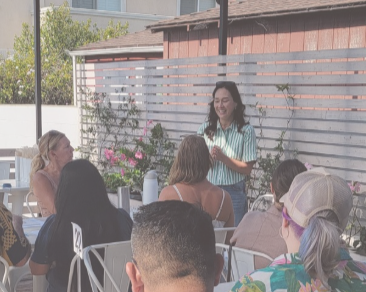
Michelle Tangeman, LMFT, BCBA
9:30-10:15 AM
Live Question & Answer
10:15-10:45 AM
Wind Down / Connection
10:45-11:00 AM
LEARNING OBJECTIVES
Why do we keep having the same fights?
How does this affect our kids?
How do we get on the same page in the long-term?
TANGIBLE TAKEAWAYS:
Why do we keep having the same fights?
Generally, parents share in their long-term goals for their children. Parents will say, “We just want the best for our kids.” The presence of conflicts between parents can be traced back to (1) a misalignment in values between parents and/or (2) differences in specific parenting strategies of how those values get played out between parents.
How does this affect our kids?
The research is clear on this. Differences in parenting that lead to high conflict and negative sentiments contribute to increased emotional vulnerabilities in our children.
Here are a few references from over the years:
Hartley SL, Papp LM, Mihaila I, Bussanich PM, Goetz G, Hickey EJ. Couple Conflict in Parents of Children with versus without Autism: Self-Reported and Observed Findings. J Child Fam Stud. 2017 Aug;26(8):2152-2165. doi: 10.1007/s10826-017-0737-1. Epub 2017 May 3. PMID: 29097880; PMCID: PMC5661987. https://pmc.ncbi.nlm.nih.gov/articles/PMC5661987/
WANG Mingzhong, FAN Cuiying, ZHOU Zongkui, CHEN Wu. (2014). Parental Conflict Affects Adolescents' Depression and Social Anxiety: Based on Cognitive-contextual and Emotional Security Theories. Acta Psychologica Sinica, 46(1), 90-100. https://journal.psych.ac.cn/acps/EN/10.3724/SP.J.1041.2014.00090
Dadds, M.R., Powell, M.B. The relationship of interparental conflict and global marital adjustment to aggression, anxiety, and immaturity in aggressive and nonclinic children. J Abnorm Child Psychol19, 553–567 (1991). https://doi.org/10.1007/BF00925820
HOW DO WE GET ON THE SAME PAGE IN PARENTING
Step 1: Identify Your Values
Here are a few values exercises that may help you to identify your core values in parenting right now.
100 Values shared by Michelle Tangeman, LMFT, BCBA
Core Values Exercisean alternative exercise that can be used
Remember, values are different from goals. Knowing our values helps to inform the decisions we make.
Step 2: Get Behaviorally Specific About Your Values
After identifying your top 2-3 values, identify both active phrases and your personal mission statement as a step towards getting on the same page in parenting and in your relationship.
You can use this Personal Values Worksheet to guide your process. Be sure download a copy so that you can make personal edits to the worksheet.
Step 3: Make Time To Have A Conversation Targeting Your Actionable Steps
Sit down with your counterpart or co-parent to address the important topics that were highlighted for you.
You can use this Values Planning Worksheet to guide the conversation.Be sure download a copy so that you can make personal edits to the worksheet.
A Few Important Reminders:
Getting On the Same Page In Parenting is not an easy 3-step process.
This requires personal responsibility and the ability for each person to regulate their own emotions before coming to the table.
The frequency of conversations will likely be determined by the needs of each family.
A SPECIAL THANK YOU TO
Mychal’s Cafe & Bakeryfor hosting our After Dinner Chat. Mychal’s Café is a bright and welcoming social enterprise created by Mychal’s Learning Place to provide students with developmental disabilities meaningful job training and employment opportunities. Every visit helps support inclusion, empowerment, and connection.
Located at 2302 Artesia Blvd, Redondo Beach, CA 90278
For pure joy and smiles, follow them on Instagram @mychalsbakery.
The TBH Movement has pledged to give $1,500 through The TBH Impact Grants in 2026.